Estimates of past atmospheric CO2 can be made from sodium carbonate minerals formed in ancient saline-alkaline lakes. That is because this class of saline minerals contains carbonate and bicarbonate in its crystal structure. The amount of dissolved carbonate in the paleolake and the associated partial pressure of atmospheric CO2 control which sodium carbonate forms. At 1 atmosphere pressure and present atmospheric CO2 of 410 ppm, trona (NaHCO3•Na2CO3•2H2O) crystallizes at temperatures above ~25°C in modern alkaline saline lakes in North America, South America, and Africa. Natron (Na2CO3•10H2O) forms at low temperatures in cold climate lakes, but nahcolite (NaHCO3) is rare because it precipitates only under CO2 much elevated above modern concentrations (Jagniecki et al., 2015). In modern alkaline lakes with surface water PCO2 similar to global atmospheric pCO2, the abundance of trona shows that sodium carbonate deposition follows equilibrium thermodynamic predictions.
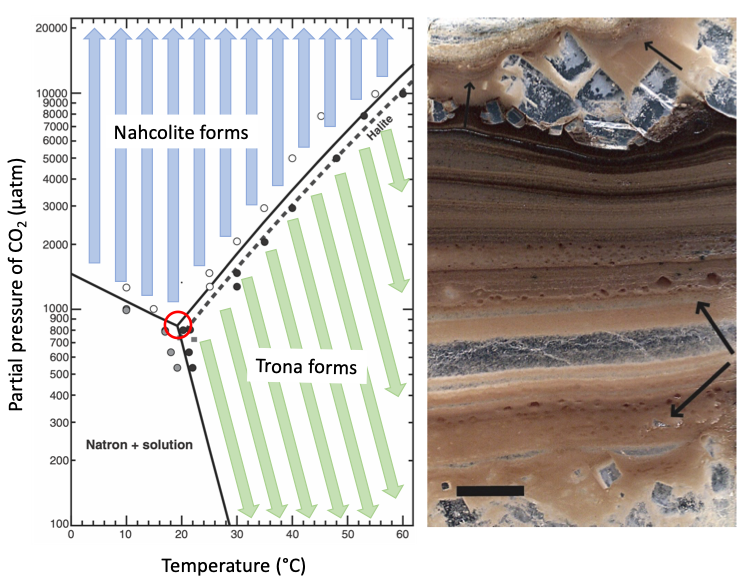 Figure Caption. Left panel: Stability fields of nahcolite,
trona, and natron as a function of temperature and atmospheric pCO2
at the air/water interface. Minerals and solution are in equilibrium
with gas at 1 atm total pressure. Symbols present experimental data
points that bracket mineral stability boundaries (solid black lines);
white circles represent stable nahcolite precipitates, black circles
stable trona precipitates, and gray circles stable natron precipitates.
The red circle highlights the triple point at which all three minerals
are stable, blue and green arrows describe whether nahcolite or trona
dominate the mineral phase. Figure modified from Jagniecki et al. (2015). '
Right panel: Thin section photograph of primary microcrystalline nahcolite
(brown millimeter scale laminae) and halite (clear crystalline layer in
middle and individual cubes at bottom and top). Nahcolite + halite
laminae (large arrows, with small halite cubes and platy “rafts”) are
composed of crystals originally precipitated at the air-water interface
that sank to the brine bottom. Microcrystalline nahcolite drapes large
vertically directed crystals of halite formed at the brine bottom (top,
small arrows). These primary evaporite mineral textures indicate that
nahcolite and halite formed in a saline-alkaline lake and not during burial
diagenesis. Scale bar is 10 millimeters. Picture credit: David Tuttle
Figure Caption. Left panel: Stability fields of nahcolite,
trona, and natron as a function of temperature and atmospheric pCO2
at the air/water interface. Minerals and solution are in equilibrium
with gas at 1 atm total pressure. Symbols present experimental data
points that bracket mineral stability boundaries (solid black lines);
white circles represent stable nahcolite precipitates, black circles
stable trona precipitates, and gray circles stable natron precipitates.
The red circle highlights the triple point at which all three minerals
are stable, blue and green arrows describe whether nahcolite or trona
dominate the mineral phase. Figure modified from Jagniecki et al. (2015). '
Right panel: Thin section photograph of primary microcrystalline nahcolite
(brown millimeter scale laminae) and halite (clear crystalline layer in
middle and individual cubes at bottom and top). Nahcolite + halite
laminae (large arrows, with small halite cubes and platy “rafts”) are
composed of crystals originally precipitated at the air-water interface
that sank to the brine bottom. Microcrystalline nahcolite drapes large
vertically directed crystals of halite formed at the brine bottom (top,
small arrows). These primary evaporite mineral textures indicate that
nahcolite and halite formed in a saline-alkaline lake and not during burial
diagenesis. Scale bar is 10 millimeters. Picture credit: David Tuttle
The laboratory experimental work of Jagniecki et al. (2015) defined the PCO2 and temperature conditions at which nahcolite, trona, and natron form (Figure E left panel). The triple point at which all three minerals are stable in the laboratory occurs at PCO2=840 μatm (19.5°C). These data show that the occurrence of nahcolite in an ancient evaporite deposit can establish a robust lower limit of atmospheric pCO2 of 840 μatm. The addition of NaCl to the brines allows nahcolite to form at aqueous PCO2 as low as 680 μatm, which is shown by the lower end of the dashed nahcolite-trona univariant line (halite saturation and 19.5°C). Knowledge of the lake brine temperatures at which nahcolite or trona precipitated can further constrain atmospheric paleo-CO2. For example, the lower limit of PCO2 at which nahcolite precipitates rises substantially as temperature rises, from 680 μatm at 19.5°C to 1910 μatm at 34°C, referenced to a halite-saturated system). Based on this experimental work, the lower PCO2 limit of nahcolite precipitation can be constrained, but the upper limit cannot (i.e. there is no upper limit to the arrows on the figure, left panel). In contrast, the occurrence of trona in an ancient lake deposit can establish an upper limit of PCO2, for example 680 μatm at 19.5°C and 1910 μatm at 34°C, whereas the lower PCO2 limit cannot be constrained. Because conditions to precipitate trona occur almost throughout the entire Cenozoic, the presence of trona has less value in paleobarometry than the presence of nahcolite.
The nahcolite proxy necessitates petrographic study of the sodium carbonate minerals under consideration, to ensure that the minerals formed at the surface (air-water interface) of a saline-alkaline lake and not during burial (Figure right panel). Limitations of the nahcolite proxy include the relative rarity of sodium carbonate deposits in the geologic record (they are confined to the Cenozoic because of weathering/erosion processes), and potential non-atmospheric sources of CO2 such as decomposed organic matter and volcanic contributions, both of which can elevate pCO2 above atmospheric values. Finally, unlike at sea level, the partial pressure of a gas (pCO2, unit μatm) at higher altitudes is not equivalent to the mole fraction of that gas (xCO2, unit ppm, see FAQ How are atmospheric levels of greenhouse gases reported? The differences between partial pressure and mole fraction), and the partial pressure reconstructed from mineral phases in mountain lakes would need to be converted to xCO2 to be comparable to ice core and other paleo-CO2 estimates. However, the mineral stability fields shown in the figure might also change at lower atmospheric pressure, and such a conversion would need to be tested experimentally. For more information on the nahcolite proxy, see Lowenstein and Demicco (2006) and Jagniecki et al. (2015).
The figure above shows a simple flow chart of the different parameters required to calculate CO2 from this proxy. A template for entering new paleo-CO2 estimates from the nahcolite proxy can be found here. For adding new data, please fill out the template and submit it to the paleo-CO2 database at the NOAA National Centers for Environmental Information (formerly known as the National Climatic Data Center, NCDC), using email address paleo@noaa.gov.
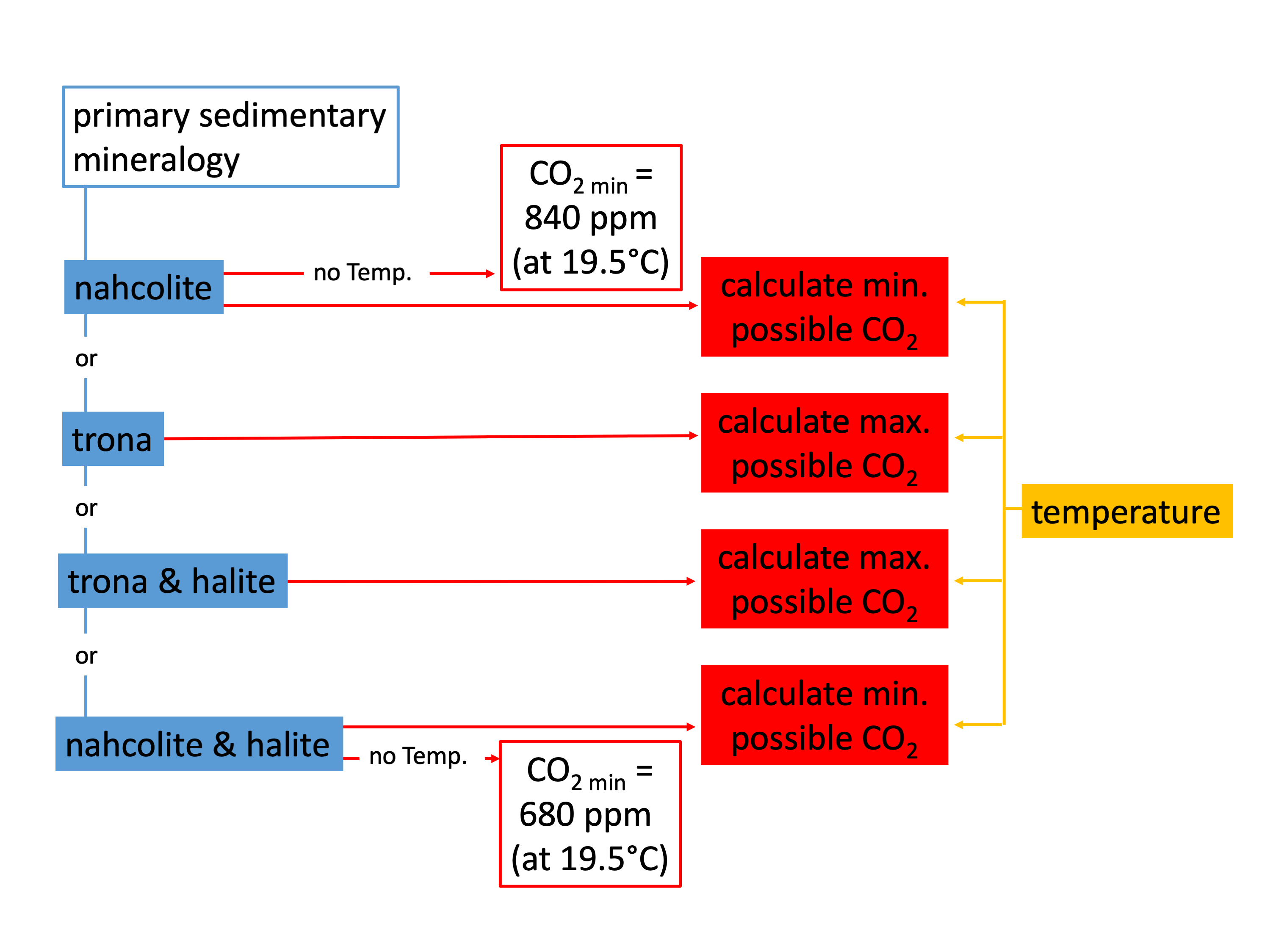 Nahcolite/trona proxy flow chart
 References cited
Jagniecki, E.A., Lowenstein, T.K., Jenkins, D.M. and Demicco, R.V. (2015) Eocene atmospheric CO2 from the nahcolite proxy. Geology 43, 1075-1078.
Lowenstein, T.K. and Demicco, R.V. (2006) Elevated Eocene atmospheric CO2 and its subsequent decline. Science 313, 1928.